News Story
Here at CFT, we’re committed to reducing our environmental impact and reaching carbon net zero. We’re working with Theatre Green Book and aiming to reach their advanced standard across the organisation as soon as possible. Read on to find out more about what we learnt from the shows that we tracked in our Festival 2025 season using the Theatre Green Book.
What is Theatre Green Book?
Theatre Green Book offers a set of guidelines to help theatres reduce the environmental impact of our shows, buildings and operations. This includes a method for tracking carbon emissions for each production. This helps us to learn and evolve how we make theatre in line with our Carbon Net Zero goals.
Visit our Theatre Green Book webpage to watch a short video and read more about our journey so far.
Navigating this page
For each show, you’ll find which Green Book level it reached (basic, intermediate or advanced), followed by some highlights, challenges, and key lessons.
We track the materials used in three areas: sets and scenery, costume, and props and furniture. All three areas must be at least 50% reused or recycled for the production to meet Green Book basic standards.
- Source = the percentage of the materials used that were reused or recycled.
- Future life = how many were stored or re-purposed after the show.
Festival Theatre productions
Across our Festival 2025 season, we tracked more shows in the Festival Theatre than we have before. We successfully reused or recycled a high proportion of costumes and props. Scenery will be a priority area going into Festival 2026. Given the size and shape of the stage, the set was often the most difficult piece of the puzzle.
The Government Inspector
This production didn't meet Theatre Green Book basic standards as the set and scenery didn't meet the required 50% reused or recycled materials.
Set: 26% source, 34% future life
Costume: 93% source, 100% future life
Props: 62% source, 100% future life
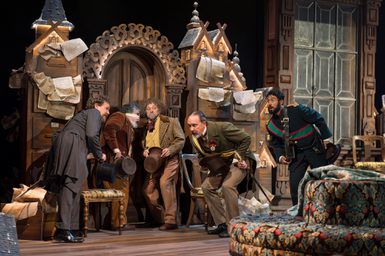
Wins
As is often the case for period productions, this scored high on both costume and props. Of the almost 250 items of clothing used in this show, over 150 were hired and over 70 came from our store. This production was a testament to our Props Store, with most of the props and furniture coming from our own stock. Read more in this news story.
The intricate houses which formed a big part of this design have since been re-used in multiple productions, so whilst they were made new, we hope they will continue to be enjoyed by audiences for years to come!
Challenges
Many aspects of the set were part of the comedy throughout the show, so they needed to be functional and therefore made new and bespoke.
Learnings
There will always be a balance to be struck between the creative ambitions for the show and the sustainability of the design elements. Sometimes things will need to be created new, but we might be able to make them from recycled materials or keep them for future use.
Anna Karenina
We tracked this production retrospectively using the Green Book, we didn’t produce it with a particular target in mind. Given this, it is very encouraging that it only just missed basic standards.
Set: 44% source, 46% future life
Costume: 88% source, 100% future life
Props: 52% source, 97% future life
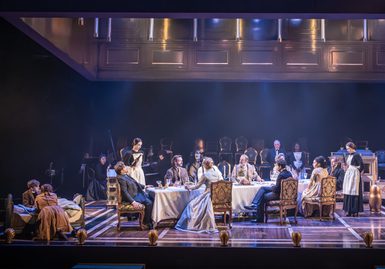
Wins
This production was previously staged in Japan, so many of the props and costumes could be re-used. Transport is not tracked at the basic level of Green Book, but we’d be keen to delve into this further if we reuse production elements from abroad again.
Challenges
Lots of the set was built from new to suit the space and could not be reused or recycled.
Learnings
Whilst we are still in the relatively early stages of making productions more sustainably, it is helpful to begin by tracking shows and gathering learnings.
This show highlighted the importance of developing set and scenery that can be reused across a range of productions, and our team are prioritising this moving forward. We're investigating modular flooring that can be re-used for a range of designs.
Lord of the Flies
This production narrowly missed basic standards, which was surprising given its minimal style. Like the other two dramas in the Festival Theatre, we learnt a lot from this show.
Set: 49% source, 55% future life
Costume: 48% source, 100% future life
Props: 31% source, 60% future life
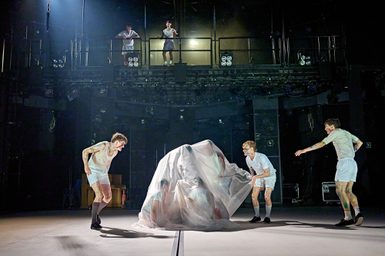
Wins
The set was especially close to reaching Green Book basic standard. The team found ways to make some elements more sustainable: the plastic sheet used in the show was amended to a biodegradable option, and the microphone was not destroyed to the same extent as initially planned.
Challenges
Whilst there were relatively few props, costumes and set elements used in this show, each item was very important to the storytelling. They needed to be functional, tailor made and not reusable.
Learnings
Theatre Green Book have since set up a focus group for theatres and companies who are producing shows with minimal set and scenery to support and advise each other.
This was the first time our Green Book Coordinator, Angela, watched a run through of the show in the rehearsal room, to understand how each item was used in the show. Moving forward, Angela will continue visiting rehearsals.
Minerva Theatre productions
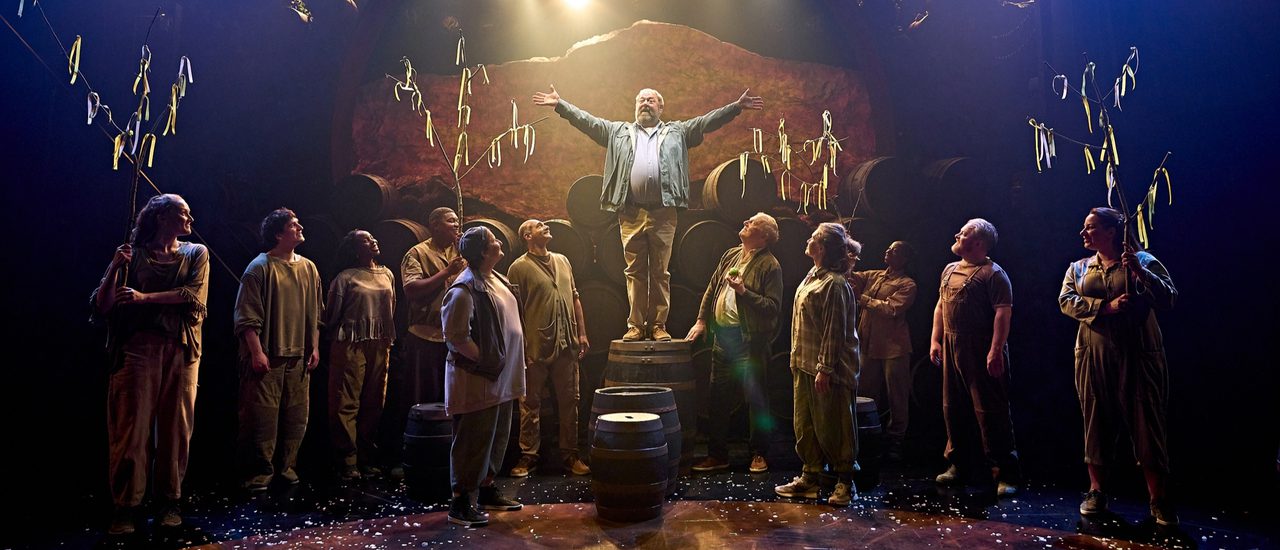
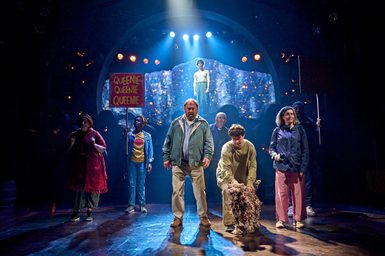
The Unlikely Pilgrimage of Harold Fry
We are especially encouraged that this production met basic Green Book standards as musicals are notoriously more challenging. Read the news story to learn more.
Set: 68% source, 100% future life
Costume: 50% source, 100% future life
Props: 73% source, 100% future life
Marie and Rosetta
As this show was a co-production with Rose Theatre, Kingston, we didn’t track it in the usual way. We’ve recently been chatting to the team at Rose about their own Theatre Green Book journey.
An important part of making theatre more sustainably is collaboration across the industry to share learnings and resources.
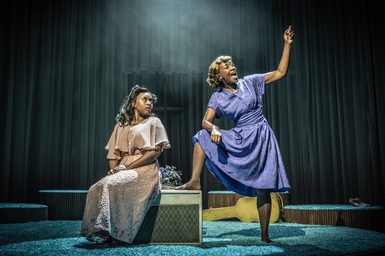
In the future, we’d like to continue tracking our shows when they transfer to London’s West End or go out on tour, to better understand the impact of more of our productions going out to audiences beyond Chichester.
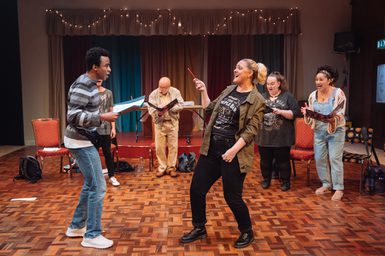
Choir
This production achieved intermediate Green Book standards - an absolute testament to the whole team's commitment to working sustainably.
Set: 70% source, 29% future life
Costume: 79% source, 79% future life
Props: 91% source, currently in storage
Wins
For the first time, there was a Theatre Green Book section as part of the rehearsal notes (circulated to those working on a show at the end of each day), to flag potential challenges before they arose and celebrate wins along the way.
In the initial design, there was a balloon drop at the end of the show, which was replaced by a confetti cannon, which was a more sustainable option.
The Production Manager, Jacqui, fully embraced Theatre Green Book and was the first freelancer to return to CFT to complete their Carbon Literacy training after working on a show with us.
Learnings
We hope to continue inspiring freelancers who work on our shows to go into future jobs equipped with Theatre Green Book knowledge to share across the industry.
Hamlet
This production narrowly missed basic Green Book standards.
Set: 45% source, 45% future life
Costume: 70% source, 100% future life
Props: 36% source, 91% future life

Challenge
As everything is tracked by weight when working with the Green Book, the large table and many chairs which were key to this design had significant implications for the overall impact of this production.
Win
The mound of mud was created from re-used rubber crumb, the palettes came from Aldingbourne Community Centre, and many of the props and costumes were hired from the RSC.
Learnings
Going into Festival 2026, we are aiming to track the shows before they go into technical rehearsals. Often, last-minute decisions have greater environmental implications as the timeline is tight and there are competing priorities. We hope that if everyone knows how the show is doing going into tech, we can work together to stay on track.
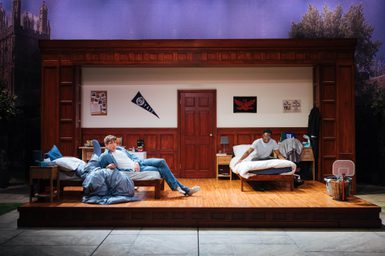
Safe Space
This production was a huge success across all three areas and achieved basic standards.
Set: 64% source, 68% future life
Costume: 61% source, 100% future life
Props: 52% source, 52% future life
Challenge
The period and Yale University setting were very important to this show and story. Some very specific props and furniture were chosen to bring the setting to life and match what would be found in an American dorm room. The team worked hard to source lots of items from our store and buy second-hand where possible which helped the show to meet Green Book standards.
Learnings
It was especially encouraging to see our efforts to reduce the impact of our set and scenery paying off with this production and we will take these learnings into the new season.
Conclusion
We feel in a strong place going into Festival 2026 equipped with our learnings from last season. We’ve welcomed some new members of the technical team who have embraced Theatre Green Book whilst learning the ropes at CFT, so they are going into the new season energised to keep reducing our environmental impact.
Our aim for Festival 2026 is to track the summer musical for the first time and work towards at least basic Green Book standards on every other show in the season. Keep an eye on the news section on our website and our LinkedIn page for updates as we go.