News Story
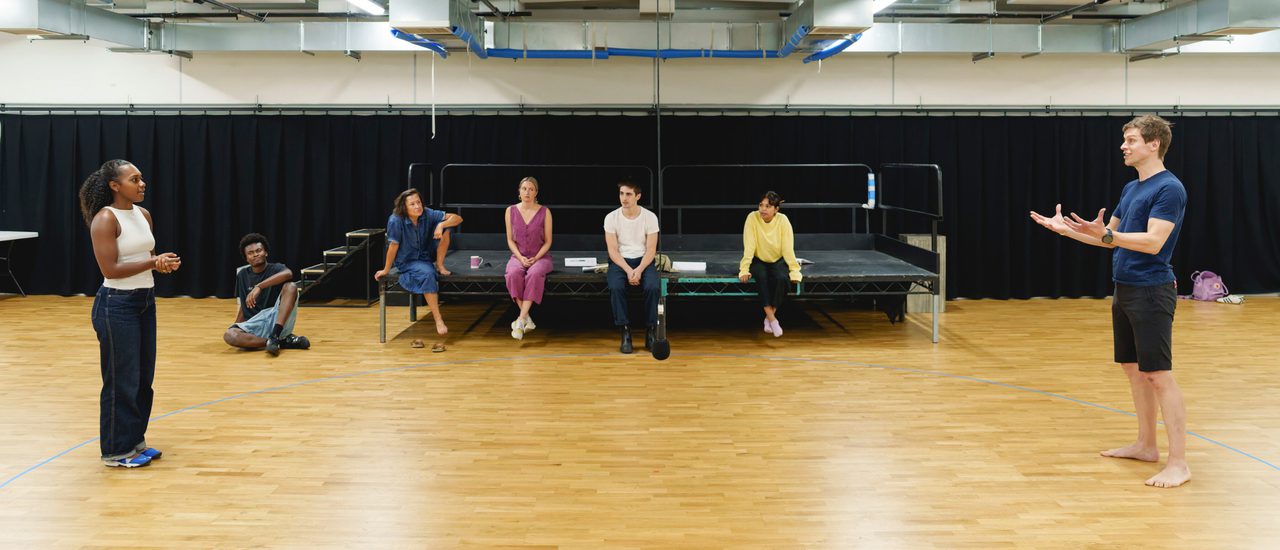
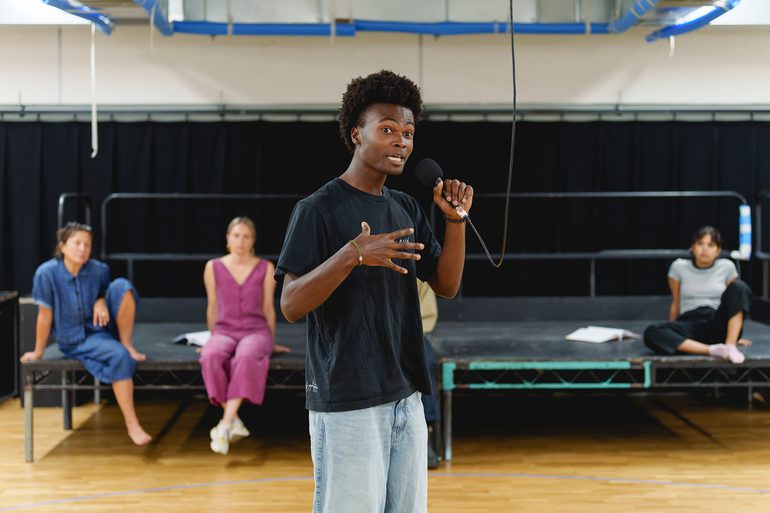
Closing the Festival Season in the Minerva Theatre is Nina Segal's powerful new adaptation, Antigone Exits. Discover more about the play from Nina and director Jeff James in this Q&A and scroll through the rehearsal photos. Antigone Exits runs for just three weeks from 26 September.
Nina, could you start by telling us about why you felt this play was relevant for today’s audiences? What made you want to adapt Antigone?
Nina: I think there’s something really interesting about adapting classics, plays that are centuries old which have stayed part of the conversation. And so, when I was approached by Chichester to adapt it, I went away and re-read Antigone and was asking myself: ‘how could I make this contemporary?’.
The original story begins the day after a war, in which Antigone’s two brothers, Polynices and Eteocles, were fighting on opposite sides and they’ve both killed each other. So Antigone’s uncle, Creon, has become the new king. And he says that no one can bury Polynices. But Antigone refuses to abide by that decree. Antigone buries Polynices. Creon has said that whoever buries him will die. So he is put in the position where he must decide whether his niece will die.
I think there's something interesting in this question of the people versus the state and what role the state gets to play in deciding what is right. That is where a lot of the contemporary relevance came in. What happens when the state starts to take a role in people deciding what happens to people at the end of their life?
Jeff, you’ve also worked on quite a few adaptations of celebrated classics. What is it that attracts you to this kind of work?
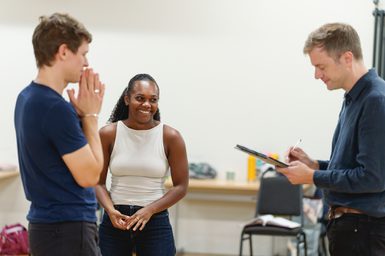
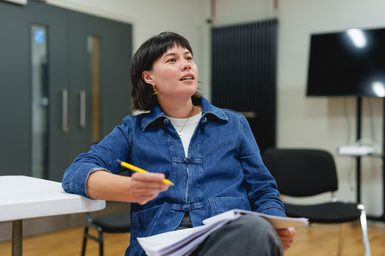
Jeff: What I really love in my work is taking a text from hundreds or even thousands of years ago and making it really live for an audience of today. What’s amazing about Antigone is that the Sophocles play was written at the dawn of theatre. People were working out: what does it mean to move from telling a story in a circle together to some people becoming storytellers and others becoming the characters? Nina’s adaptation really plays with that discovery of what theatre is today. And I found that really exciting.

And the actors themselves are also characters in the play. What has the process of working with them been like? What have they brought to it as actors playing actors?
Jeff: I think for the audience watching it, you can't quite tell where the actor ends and the character begins. As we get to know the brilliant seven actors we’ve got in the rehearsal room, it’s exciting to see what they bring as themselves. I really like it when the audience can’t quite see the gap between the actor and the character and I think that this play engages with that an awful lot.
What I love about the Minerva is that it's a democratic space where the audience and the actors are all in one room. They're sharing this story. It’s so intimate and the audience are so involved in what’s happening. They can really see the sweat on the actor’s brow. There’s an interesting interplay between actor, character, and audience, and I’m really excited to get into the theatre and add the audience to that equation and see how this epic story takes shape with everyone there together.
Nina: And for me, writing it, it's a way to explicitly set it now. These actors exist now and you understand that when the show ends, they're going to be on their mobile phones and they're going to get a bus back home. It’s a very immediate way of meshing this classical world with the contemporary world.
When you're adapting classics, you're asking yourself: are they wearing jeans? Are they existing now or are they existing in a time of chariots? And I think with this production we have both. They do talk about chariots and libations, and then they can switch immediately to talking about a news event that is happening right now.
Could you tell us a bit about the design?
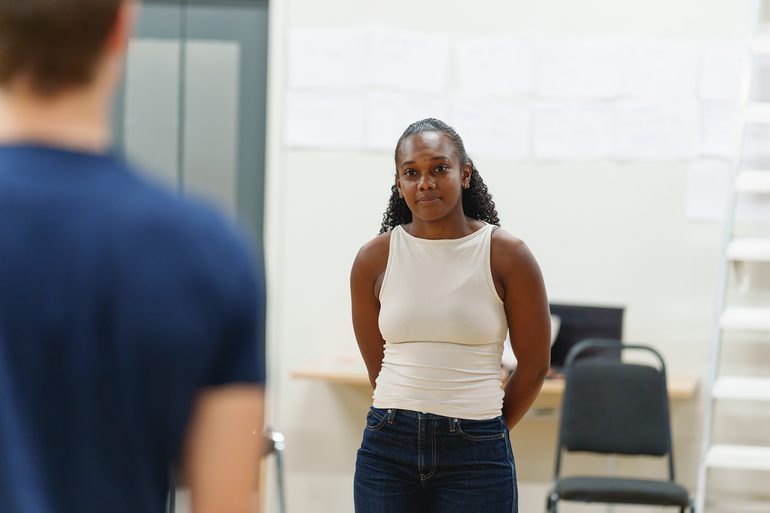
Jeff: Working with Alex Lowde, the designer, we were trying to find a space that was very elemental and simple, but that felt completely of today. We were looking at references from contemporary architecture in Asia that inspired this big gesture in the space. Nina's got this amazing stage direction that we just couldn't afford to deliver. And so we found a poetic way of expressing it.
Nina: It was an impossible stage direction! I had written that the theatre space essentially cracks open and becomes a mountain for a second, and then the mountain closes again. And Alex and Jeff working together have come up with this beautiful version which I’m really excited to see. It’s a sort of metaphor for when somebody dies and they’re gone.
There’s an idea that if you go against the rules of right and wrong and if you don’t bury bodies properly, if people who should not die are killed and you don’t allow space to mourn what has happened, then Thebes will be cursed. That was a strong thread for me in adapting this as a contemporary writer. What could that mean now? What does it mean for our society to be cursed in a world where we don’t believe in gods or prophecies anymore?
Have you thought about what you want the audience to be left with after this production, or what you hope they will feel?
Nina: I really hope it's going to be a play that moves people. There’s an idea in ancient and classical theatre about catharsis, which is essentially the idea that you watch something and it allows you to purge your own emotions or your own experiences.
I've never done a play that's actively looking for that. But with this play, I think it is really important. The play draws on a number of really contemporary events and issues in the world today. And because each of these seven actors has a monologue relating to a personal or political event that's happening now, I hope it leaves space for the audience to think about their own relationship to grief or mourning and all of these big themes of Antigone. I'm hoping that people will come out thinking about Antigone, but also about themselves, their own experiences and the world they're living in.
Antigone Exits premieres in the Minerva Theatre on Saturday 26 September. Visit the show page to book now.